

Improving change management in manufacturing involves far more than installing new software or tinkering with procedures. True transformation requires weaving culture, leadership and operations into a cohesive whole so that every team member feels ownership of both the problems and the solutions.
In this article, we draw on lessons from culture and change management expert John Bergmann to explore why most factory-floor change efforts stall, and how top plants build resilient, people-centric strategies that deliver lasting results.
Disclaimer: This article is for informational purposes only and does not constitute legal, financial or operational advice. Always consult qualified professionals when designing your manufacturing change strategy.
Why Most Change Efforts Fail on the Factory Floor
Manufacturers often treat change as a single project with a clear start date and a one-day go-live event. They roll out new procedures, hardware, or software and expect teams to adapt instantly. On the shop floor, however, operators see these changes as extra work and disruption. Without a clear connection to daily challenges, they revert to old habits the moment management’s attention shifts elsewhere.
John Bergmann emphasizes that culture underpins everything: “Culture is how things are done. You can have SOPs and certifications galore but if your culture does not support new ways of working, they will not stick.” In practice, this cultural mismatch manifests as:
Low training attendance
• Operators skip optional knowledge sessions to keep up with production quotas
• Teams view classroom hours as time away from their real work
Stalled pilots
• New processes implemented on one line never expand to other lines
• Initial momentum dissipates as team leads lose faith in management support
Firefighting mindsets
• Managers enforce change through audits and warnings rather than coaching
• Frontline teams create workarounds to bypass perceived bottlenecks
Top-performing plants avoid these traps by treating change as a continuous journey. They break large initiatives into smaller, measurable milestones. They celebrate the first handful of successes publicly – for example, the first week with zero batch-record discrepancies – to build momentum. They solicit real-time feedback, pivot quickly when an approach fails, and keep everyone informed. Over time, this iterative process shifts attitudes from resistance to genuine engagement.
The Culture Trap: Why New Tools Alone Do Not Work
Many companies believe that cutting-edge tools – an ERP upgrade, a modern MES or electronic batch records – will by themselves solve change challenges. Yet John Bergmann warns that technology without cultural readiness is like planting a tree on concrete: “If culture does not support new tools, they will sit unused or be bypassed entirely.”
In leading plants, tool rollout is only one piece of a broader culture strategy:
Purpose-driven storytelling
• Before launch, leaders explain how each feature reduces risk, waste or rework
• Use real examples: “When we scanned ingredients in real time, we prevented a salt-for-sugar mixup valued at $15,000”
Operator co-creation
• Invite volunteers from frontline teams to test prototypes and suggest interface tweaks
• Host “design jams” where operators propose simplified screens, drop-down lists or custom alerts
Champions and rituals
• Identify early adopters as day-to-day coaches for peers
• Establish daily or weekly huddles where teams share “tool hacks” and success stories
”Rather than a one-off software installation, top plants view digital tools as living extensions of their culture. They ensure that every new feature ties directly back to shared values – quality, safety, customer satisfaction – so that technology becomes part of “how things are done” rather than an alien imposition.
Leadership Mistakes That Kill Change Before It Starts
Even the most well-designed change strategy collapses without clear, visible and consistent leadership. John Bergmann calls leadership “the box through which culture is delivered to the world.” When leaders are absent from pilot sessions, training workshops or daily huddles, change messages get lost amid the noise of daily production.
Common leadership missteps include:
Untrained champions
• Technical experts promoted into change roles without change-management skills
• Champions lack strategic coaching techniques and defer to “drive” rather than “guide”
No dedicated time or resources
• Managers are expected to oversee change alongside full operational duties
• No calendar “ring-fenced” for project work, so it gets deprioritized under pressure
Mixed messages
• One week quality is preached, the next week speed is mandated
• Incentives tied strictly to volume provoke operators to bypass new quality measures
By contrast, high-performing plants employ these leadership practices:
Governance forums
• Weekly cross-functional meetings to review progress, remove roadblocks and update KPIs
• Participants include operations, quality, maintenance and HR – voices from every corner
Change hours
• Each manager allocates specific hours weekly for floor coaching, training or feedback sessions
• Attendance at these sessions is a required part of performance reviews
Incentive realignment
• Tie a portion of bonuses to adoption metrics (e.g. reduction in deviation rate or number of suggestions implemented)
• Reward leaders for both volume and quality improvements
These leadership behaviors reinforce that change is not optional but essential to the plant’s ongoing success.
Ignoring Frontline Teams? Expect Failure
Change imposed from the top without input from the people who run the machines is doomed to sputter. John Bergmann emphasizes that true transformation begins when operators move from passive recipients to active co-creators. When frontline teams see their ideas reflected in new processes, they embrace change instead of resisting it.
Leading plants engage operators through hands-on collaboration:
On-floor Design Workshops
• Bring together small cross-functional squads (operators, supervisors and engineers) to walk every step of the current process and capture real-world challenges
• Use simple tools such as sticky notes and process flow sketches to identify the five highest-impact pain points and co-invent low-cost, high-value fixes
Value-Stream Ownership
• Empower each operator to treat their “next process” as an internal customer, creating intrinsic motivation to deliver right‐first‐time outputs
• Formalize this mindset by linking every hand-off to a short “value statement”; for example, “I verify fill weight so my colleague can package without re-inspection”
Peer Coaching Networks
• Appoint “change champions” on each shift who facilitate daily improvement huddles, mentor new hires and gather feedback on pilot ideas
• Reward these champions with modest stipends, public recognition or redeemable points, creating a visible incentive to sustain momentum
”By involving frontline teams in design, ownership and peer-to-peer coaching from day one, top plants turn skeptics into advocates. Solutions become practical and grounded in real production challenges, driving faster, more durable adoption of new ways of working.
How to Measure Culture Change – Beyond Surveys and Gut Feelings
Surveys and pulse checks can tell you how people feel about change, but they rarely reveal what they actually do when the pressure is on. John Bergmann argues that the most reliable window into culture is behavior-based data, hard metrics drawn from your own processes that show whether new ways of working are genuinely taking hold.
Rather than ask operators to self-report “engagement,” track the following indicators every week and then drill into any outliers for root-cause analysis:
Clerical-error rate in critical records
• Measure the percentage of batch records, inspection logs or material-receipt tickets containing typos, missing signatures or incorrect lot numbers
• Benchmark by line, shift and operator. If one team consistently posts a 5 percent error rate while others sit at 1 percent, it signals a localized breakdown in attention to detail or training gaps
• Follow up with focused “error hunts,” where teams review real records together to identify ambiguous form fields or confusing workflows that need redesign
Deviation-to-CAPA lag time
• Track the average hours between a deviation being logged and a corrective action being assigned, plus the time until that action is verified as effective
• Long lags of more than 48 hours indicate either insufficient resources for investigations or a mindset that deviations are someone else’s problem
• Set a rolling goal (for example, 24 hours to assign and 72 hours to verify) and highlight teams that meet or miss these targets in your weekly governance forum
Idea-submission volume and resolution rate
• Count the number of process-improvement suggestions submitted by frontline staff each week, then measure what percentage are implemented or formally rejected with feedback
• High submission volumes coupled with low resolution rates indicate that people are willing to contribute but feel ignored. Low submission volumes suggest a risk-averse culture that discourages new ideas
• Aim for a sustained resolution rate above 60 percent. Even a simple “thank you” and a clear explanation for non-adoption counts as closure
Cross-functional sign-off compliance
• Monitor the share of batch records, change-control tickets or process-change requests that receive timely approvals from production, quality and maintenance
• A drop in compliance, such as quality signing off quickly while maintenance lags by several days, reveals friction points that bottleneck change
• Resolve late sign-offs in daily escalation huddles and adjust SOPs or role assignments where hand-off responsibilities are unclear
Training-to-proficiency curve
• After every new process or tool rollout, track how many batches or hours an operator requires before achieving zero-error performance
• Compare proficiency curves across teams. Steep climbs show that training materials or coaching methods need refinement, while flat curves indicate effective knowledge transfer
• Refine onboarding and continuous-learning programs based on real-world performance rather than on generic completion checklists
By focusing on these concrete, behavior-driven metrics and reviewing them regularly at all levels of the organization, you gain an objective, data-backed view of your culture in action.
When you spot a red flag, such as a spike in clerical errors or a drop in idea resolutions, you can launch targeted interventions, such as process redesigns, role clarification workshops or spot coaching, instead of relying on gut instincts or one-off surveys. Over time, this metrics-driven approach transforms culture from an amorphous concept into a manageable, measurable asset.
”By involving frontline teams in design, ownership and peer-to-peer coaching from day one, top plants turn skeptics into advocates. Solutions become practical and grounded in real production challenges, driving faster, more durable adoption of new ways of working.
Why Quotas and Targets Will Not Drive Real Transformation
Many manufacturers default to rigid production quotas—“make X units by end of shift”—only to discover that quality and innovation suffer. When operators know their bonuses or performance reviews depend solely on output, they will push parts through the line even if checks fail or processes deviate. As John Bergmann puts it, “If bonuses are tied strictly to output, quality suffers.” To create real, sustainable change, high-performing plants adopt a more balanced incentive structure that rewards both speed and excellence.
Demand-Plus Buffers
- Operators shift from “produce 1,000 units” to “deliver 1,000 defect-free units.”
- Live dashboards show two figures side by side: total output and defects per million. This dual view encourages decisions that balance throughput with product integrity.
Composite KPIs
- Rather than separate targets for speed, yield and quality, plants combine them into a single performance score.
- Teams earn credit only when cycle-time gains do not come at the expense of higher scrap or rework rates.
Improvement Incentives
- Frontline teams receive small bonuses or public recognition for suggestions that cut cost, reduce errors or streamline processes.
- A monthly “Innovation Spotlight” highlights the best ideas and tracks their impact, reinforcing a culture where every operator feels empowered to improve their own work environment.
Quality-First Milestones
- Set intermediate goals such as “90 consecutive minutes without a deviation” or “zero critical nonconformances in a day.”
- Celebrating these mini-wins keeps energy high and focuses teams on real-time problem solving rather than chasing raw numbers.
By tying rewards to a mix of output, defect reduction and continuous improvement, manufacturers ensure that teams see change initiatives as enablers, not obstacles. This balanced approach drives genuine transformation rather than short-lived compliance.
How ERP supports organizational change management
An ERP change management program is more than a technical rollout. It becomes the central nervous system that connects culture, leadership, frontline engagement and performance measurement in a living cycle of improvement. When configured correctly, the ERP enforces new ways of working at the point of execution, provides real-time insights to leaders, and captures data that drive the next wave of enhancements. This continuous loop transforms one-off deployments into permanent gains.
First, ERP workflows embed quality checks directly into each process step. Operators cannot move forward until ingredient lots are verified or critical in-process measurements fall within specification. These embedded quality gates act as invisible supervisors, preventing out-of-tolerance batches before they ever reach packaging. The result is a dramatic reduction in scrap, re-work and customer complaints.
Second, interactive digital instructions replace static paper SOPs. By guiding operators through tailored step-by-step procedures that adjust to batch size, formulation or equipment setup, ERP-driven work instructions eliminate ambiguity. When questions arise, built-in photos, videos and FAQs ensure swift resolution. Combined with real-time dashboards that surface deviation trends, cycle-time metrics and culture indicators, leaders have the visibility they need to coach teams proactively.
Key ERP Capabilities for Sustainable Change
Embedded Quality Gates
- Prevent operators from proceeding until ingredient lot, weight or safety checks pass
- Trigger automated holds and alerts for any out-of-spec reading
Interactive Work Instructions
- Deliver dynamic, context-sensitive SOPs on tablets or terminals
- Include rich media and inline help to reduce misinterpretation
Real-Time Dashboards
- Offer live visibility into deviations, cycle times and culture metrics
- Flag teams or shifts requiring additional coaching before issues escalate
Governance and Continuous Improvement
- Convene a cross-functional steering committee that reviews ERP data biweekly
- Track feature requests, pilot outcomes and rollout status in ERP change logs
Top-performing plants treat ERP not as a static tool but as a dynamic platform for ongoing transformation. They continuously refine workflows, automate the handoff of root-cause analyses and integrate new metrics to sustain momentum. Over time, the ERP evolves into a permanent engine of culture, leadership and operational excellence.
Conclusion
Change management in manufacturing is a holistic journey that demands more than tools or checklists. It begins with a culture that values shared purpose, is propelled by leaders who model and reinforce new behaviors, and engages frontline teams as co-creators of solutions. By measuring real behaviors, replacing rigid quotas with composite KPIs, and using ERP as a living platform for continuous improvement, top plants turn transformation into a sustainable competitive advantage.
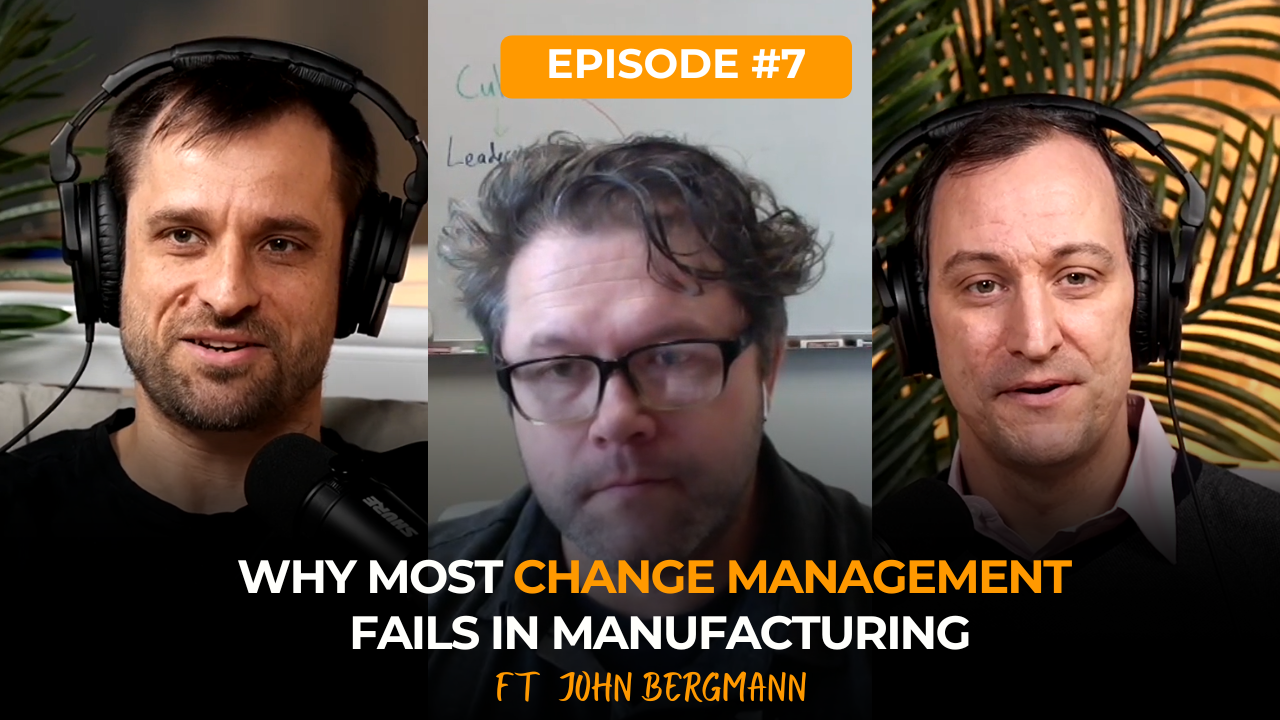
→ Watch the episode to hear John Bergmann’s full playbook on orchestrating successful manufacturing change initiatives and bringing cultural, leadership and operational excellence together.
About the Author
Alex Koves is the Vice President of Process Manufacturing at CAI Software. With over 20 years of leadership in the batch process industry, Alex has guided hundreds of manufacturers through digital transformations from fragmented, spreadsheet‑driven workflows to fully integrated ERP environments. His dual role gives him a unique vantage: he oversees Mar‑Kov’s product vision and delivery while shaping CAI’s broader manufacturing solutions strategy. Known for his collaborative approach, Alex partners closely with customer teams to ensure implementations deliver measurable gains in compliance, throughput, and cost control.
